
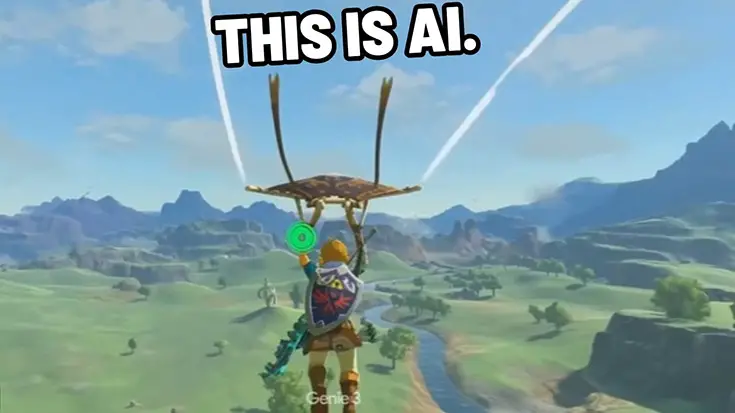
In the last few days, financial markets have sent a shockwave through the entire gaming world: after the announcement of Project Genie, a new Google tool capable of generating interactive digital worlds in real time from simple text or image prompts, the stock prices of several video game companies have suffered a sharp drop.
Companies such as Take-Two Interactive, Roblox, and Unity Software saw their shares slide by more than ten percentage points in a single session, reflecting investors’ concerns about the impact these technologies could have on the traditional video game development model.
This episode highlights a widespread fear of disruptive technology: if an AI can generate digital worlds, what will become of game engines and development studios? But the answer is not so simple, precisely because the nature of World Models, such as the one behind Project Genie, is profoundly different from that of traditional video games.
Video games: deterministic worlds, clear rules
Let’s start from the basics: a traditional video game is a deterministic system. This means that, given the same input, the state of the world always evolves in the same way. If you press a button and a character jumps, that jump will always happen in the same way and at the same point in the code. This is the principle that makes it possible to talk about skill, muscle memory, competence, and competition, because the game world is predictable and reproducible.
In multiplayer games this characteristic is even more important: every client must agree on the same state of the world, frame after frame, tick after tick. If the simulation were not reproducible in exactly the same way on every machine, the game would simply “not hold together”.
World Models: prediction, not simulation
A World Model (WM), such as the one on which Project Genie is based, works in a completely different way: it does not “simulate” a state according to precise rules; rather, it predicts the next state and renders it in real time. The next frame does not arise from an explicit rule-based logic, but from a statistical inference – essentially: what should happen, according to the data?
This leads to a fundamental consequence: if you repeated the experience twice from the same point, with the same input, you might obtain different results. For a traditional video game, which is based on the predictability and consistency of the simulated world, this would be a structural problem of no small importance.
The core of the difference: controllability vs plausibility
The paradigm behind a game engine is designed to be controllable, verifiable, inspectable, and debuggable.
A World Model, by contrast, is designed to be plausible: the goal is not to have a model of “truth” on which to build precise mechanics, but rather to generate something that makes sense visually and behaviorally. There is no reliable way to trace back the internal decision-making process that leads to a given result: you can only observe the final output, not the logical steps that generated it.
Design and rules: who decides what is possible?
In a traditional video game, the designer decides what is possible and what is not, through explicit rules and parameters defined in advance.
In a World Model, this boundary is not so easily made explicit: the model does not accept or reject certain actions based on rigid rules, but on what it has learned from data. Here too, the stability of behavior—a fundamental requirement for designing challenges or progressions—breaks down, since prediction does not guarantee the same consistency as a simulation based on fixed rules.
Why comparing WMs to AAA video games is misleading
Precisely because of these paradigm differences, it is misleading to think that World Models could soon become real AAA video games. Not because they are intrinsically inferior, but because they are designed to solve different problems: not to simulate rule-governed worlds, but to generate plausible scenarios by making use of the same probabilistic/predictive capability typical of generative AIs.
What would be needed to bring a WM closer to a game engine
It is not impossible that World Models may one day operate in contexts similar to those of a traditional game; however, to do so they would require a number of prerequisites that are currently not satisfied by this technology, including:
- Explicit constraints. It is necessary to add externally imposed rules (collisions, physical limits, inventories, states, cooldowns, progression, etc.), aimed at making gameplay reliable, repeatable, and reproducible. Needless to say, this means placing alongside the WM a symbolic layer made of collisions, physical limits, inventories, states, permissions, cooldowns, progressions, etc.: in practice, a small game engine around the model.
- Synchronization. If multiple players share the same world, someone must be authoritative over the state. To meet this requirement, an external canonical state would be needed, which the model consults and proposes to evolve, but does not directly control. Here too, the most sensible solution is a hybrid architecture: model + deterministic engine + state manager.
- Latency. A gameplay loop like the ones we are used to today requires response times on the order of milliseconds, performance levels that are currently unthinkable for generating frames or scenes through WMs. This is one of the most complex issues and is unlikely to be solved in the short term.
- Predictability. A pivotal requirement in modern game design for building challenges. If the behavior of the world is not sufficiently stable, it becomes almost impossible to design levels, missions, or progressions: design becomes reactive rather than proactive.
- Debugging. In a traditional game you can inspect a state, a variable, a rule; in a WM there is no direct equivalent of this. There is no way to trace back the decision-making process that led to a given result; you can only observe the final output.
Conclusions
The stock market reaction after Project Genie highlights something interesting: investors fear that AI could make traditional development models obsolete. However, even though WMs could certainly move closer to video games as we understand them, it is reasonable to expect that they will ultimately converge elsewhere: guided interactive experiences, non-rigorous game systems (different from video games), hybrid forms of storytelling, and so on.
Unless, of course, WMs are strongly encapsulated within structures typical of game engines. In that case, however, the model would no longer be the “engine” of the game: it would become one of its subsystems, something very close to an extremely advanced asset manager.